
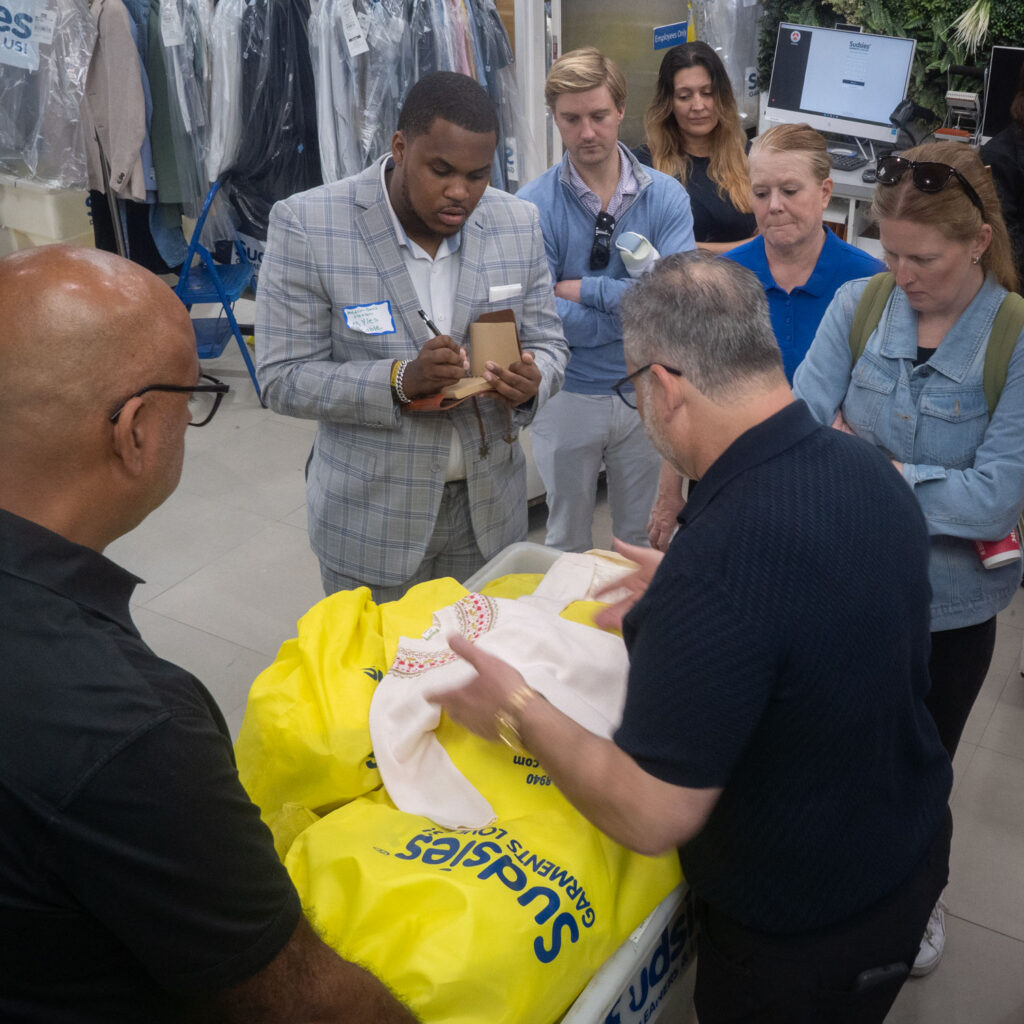
In early 2026, the team from Orchid Cleaners in Orlando made the drive to Miami for a mentoring event hosted by Sudsies and organized through a peer network called T2. They came to observe, ask questions, and bring something useful back to their operation.
What they experienced was harder to summarize than they expected.
“It’s one thing to hear about where this industry needs to go,” said Daniel Cha, owner of Orchid Cleaners. “It’s completely different to see it operating at scale. Once you see it, you can’t unsee it, and you come back thinking differently about what you’re willing to accept.”
That kind of shift, earned through shared experience rather than protected knowledge, is exactly what T2 was built to create.
A Different Kind of Peer Group
T2, a continuation of what was originally known as the Tuckman Group, is a best-practices network of roughly a dozen dry cleaning operators from across the country. Members represent markets as varied as Los Angeles, Texas, Buffalo, Louisville, Orlando, and Raleigh, North Carolina. They are intentionally spread out geographically so they will never compete with one another. That distance creates something rare in this industry: the ability to speak with complete honesty.
Three times each year, the group gathers at one member’s facility for several days of conversation, evaluation, and plant tours. Members openly review each other’s financial statements, question unusual expense ratios, and offer direct suggestions for improvement. The discussions can be pointed. They are also invaluable.
“We’re sharing everything,” said Turner Makepeace, who manages day-to-day operations at Medlin-Davis Cleaners in Raleigh, North Carolina. “The good and the bad.”
Michael Jones, owner of Highland Cleaners in Louisville, Kentucky, a twelve-location operation that has been part of his family since 1944, describes the group as functioning like a board of advisors. “When peers see your operation with fresh eyes,” he explained, “they immediately notice things that daily familiarity can hide.”
Inviting Sudsies Into the Conversation
When T2 reached out a couple of years ago and asked Sudsies to help facilitate their meetings, we didn’t hesitate. These were serious operators who were already doing something rare—opening their books, walking through each other’s plants, and having honest conversations about what wasn’t working. That’s not common in this industry. I wasn’t going to say no to that.
These aren’t transactional conversations for me. If someone shares a problem at a meeting, I want to know how it turned out. That’s just how I think relationships should work, whether it’s with a peer, an employee, or a customer bringing in a garment they care about.
What “Slow Intention” Actually Looks Like
When operators visit Sudsies for training, many expect to find some proprietary advantage, like equipment they don’t have access to, a process no one else knows. What they find is both simpler and harder to replicate.
“It’s not the machines,” Cha said. “They’re using the same equipment we have access to. The difference is perspective; how intentionally the operation is run and the standards the leadership is willing to uphold.”
One detail stood out immediately to Cha and his team: multiple spot-cleaning and touch-up inspection stations built directly into the production flow. At most operations, a garment passes through a single finishing point before heading out the door. At Sudsies, garments are inspected, refined, and re-inspected, sometimes by multiple people.
“Most operators would never believe in four touch-up stations for one shirt,” Cha said. “‘Good enough’ isn’t good enough anymore.”
He describes the approach as “slow intention,” a counterintuitive philosophy that prioritizes meticulous care without sacrificing scale. That mindset carries even more weight when handling high-end garments.
“At the end of the day, the garment doesn’t belong to us,” Cha said. “It belongs to the customer. It has value: financial, sentimental, or both. And you can’t make decisions about someone else’s property without them.”
From Observation to Execution
For Makepeace, the training visits to Sudsies have been directly tied to building something new at Medlin-Davis: a dedicated couture garment care program, branded internally as MDC Handcrafted.
Before joining his family’s business four years ago, Makepeace spent years in commercial banking. He approaches new initiatives with the same rigor he once applied to financial analysis. Launching a couture program, he understood, wasn’t something you could learn from a manual.
“You can’t really learn this in an online class,” he said. “You have to see the garments, handle them, and watch how experienced people work with them.”
At Sudsies, Makepeace spent time with the full production team: cleaners, spotters, and pressers who handle high-end garments daily. He learned to identify couture pieces by studying brand labels, country of origin, fabric content, embellishments, and construction. He also brought along the company’s newest team member, a future dry cleaner just beginning his career, because he understood the value of immersive experience early.
“He’s a sponge right now,” Makepeace said. “It was a great opportunity for him.”
Back in Raleigh, MDC Handcrafted now operates as a completely separate production track. Couture garments are handled individually, finished with custom hangers and branded packaging, and priced at an 85 percent premium over standard cleaning. The program currently serves about fifteen regular clients.
Makepeace plans to expand marketing only after the process is fully proven; a deliberate pace that reflects both his background and what he observed in Miami.
The Business as a Vehicle for People
Across all three operators, the deepest takeaway from their involvement with T2 wasn’t operational. It was personal.
Jones has watched the same non-transactional philosophy show up inside Sudsies’ walls. Team members are encouraged to grow, support one another, and aspire to the next level within the organization. Advancement isn’t treated as competition.
“Jason has created a workplace where employees feel connected to the company and to each other in a way that stands out to visitors,” Jones said. “People succeed together.”
Cha has arrived at a similar conviction. “The happiest day of my life won’t be when I buy a bigger house,” he said. “It’ll be when my team can buy homes for their families.”
It’s a philosophy that mirrors what the T2 group sees modeled in their peer relationships: high standards paired with genuine care, praise balanced with accountability, and systems designed to protect culture rather than just optimize output.
What Collaboration Actually Does for an Industry
Dry cleaning is shrinking. Fewer people wear suits. Casual dress codes and advanced synthetic fabrics have reduced reliance on professional garment care. Operators across the country are closing faster than new ones are opening. In that environment, clinging to “the way it’s always been done” is no longer a viable strategy.
T2 represents a different bet: that when operators stop guarding knowledge and start sharing it, the whole industry gets stronger. Standards rise. Public perception improves. The operators most likely to thrive aren’t those who protect their secrets most carefully. They’re the ones willing to adapt, collaborate, and lead with intention.
For the operators who have made that drive back from Miami, whether from Orlando, Louisville, Raleigh, or beyond, the lesson landed the same way every time.
Not delivered. Experienced.