
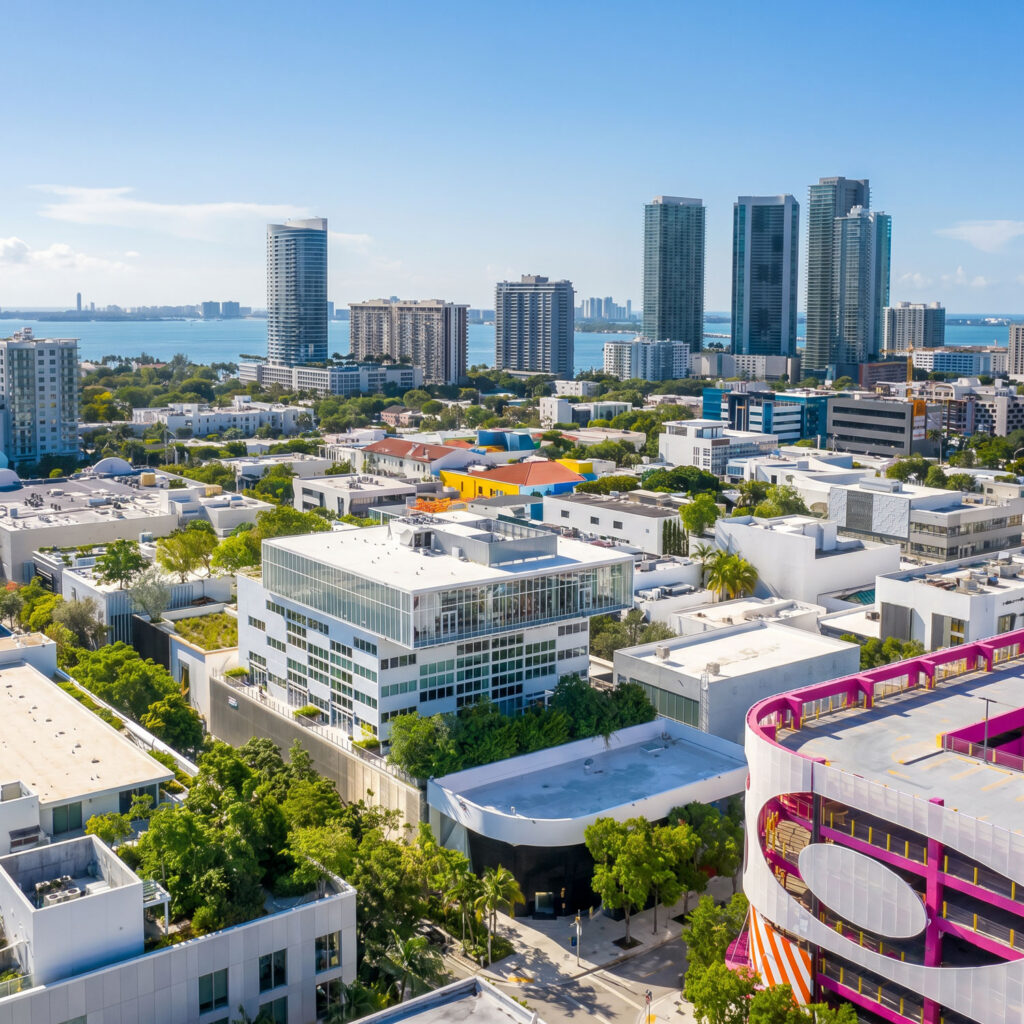
South Florida has long interested me as more than a market. It is a case study in reinvention and growth because few American regions make change as visible as this one does. New towers rise quickly. Downtown business districts keep redrawing themselves. West Palm Beach has become far more assertive about its future as an office and finance center. Miami continues to market itself as both a cultural capital and a serious business destination. Even the underlying population story shows how much motion the region has absorbed: from 2020 to 2025, Palm Beach County grew 5.5%, Miami-Dade 4.0%, and Broward 3.6%, all above the national 3.1% increase over the same period, while Monroe moved in the opposite direction.
What makes South Florida instructive is that its reinvention has never been purely cosmetic. It is not just a place where buildings appear. It is a place where the ambitions of finance, hospitality, real estate, healthcare, and technology have all begun competing for real civic space. Citadel describes Miami as “on a path to becoming a destination of choice for the global financial industry,” and Related Ross has framed West Palm Beach as “the new beacon of innovation, culture, and community.” Those are promotional statements, of course, but they are also revealing ones. They show how the region is now being narrated by serious capital as a place where the next version of business life is being built, not merely visited.
That pace of change is energizing, but it is also destabilizing. South Florida’s own regional economic strategy says plainly that the region has made meaningful progress, while still facing serious constraints in infrastructure, housing affordability, and workforce training. The same report notes that transportation inefficiencies, illustrated by the Miami metro area’s congestion, are costing the region about $3.1 billion annually, and that housing affordability remains a critical issue across Palm Beach, Miami-Dade, and Broward. That is exactly why I see South Florida as such an honest case study. It makes the upside of growth highly visible, but it also makes the carrying costs visible.
One lesson the region teaches is that reinvention creates opportunity only when people know how to interpret it. South Florida has repeatedly attracted entrepreneurs and institutions willing to bet on transformation, but not every bet is equally intelligent. The Miami Downtown Development Authority offers a useful micro-example. It is not just financing spectacle. It is using grants to attract retailers, service businesses, mid-sized firms, and startups in ways meant to increase street-level activity, diversify the business mix, and build long-term presence in the urban core. That is the difference between reinvention as visibility and reinvention as ecosystem-building. The former looks dramatic. The latter has a better chance of lasting.
Another lesson is that growth changes expectations. As communities become wealthier, more international, and more professionally networked, they expect more polish, more convenience, and more coherence from the businesses around them. Related Ross’s West Palm materials are candid about this shift, emphasizing new Class A+ office inventory, hospitality-driven amenities, and an effort to “redefine the future of work.” Citadel’s Miami materials describe Miami not just as a warm-weather relocation, but as a place for talented professionals, businesses, and culture. In plain English, that means the market is becoming more demanding. Once a region begins attracting global firms and globally mobile talent, the local standard for service rises with them.
I also think South Florida demonstrates that place identity matters more than boosters sometimes admit. Reinvention works best here when it does not erase the qualities that made the region compelling in the first place. Florida International University and The Miami Foundation have both studied what drives community attachment in Miami, identifying social offerings, openness, and aesthetics as major factors. That finding feels right to me because South Florida has always been part aspiration and part lived ritual. It is glamour, yes, but it is also routine, familiarity, language, family networks, neighborhood loyalties, and the repeated texture of daily life. Businesses that succeed here usually understand both sides of that equation.
At Sudsies, operating in South Florida means serving a uniquely dynamic blend of guests, lifestyles, and expectations. It means understanding luxury without becoming generic. It means delivering convenience to people with demanding schedules while preserving warmth and continuity in a region that can otherwise become transactional very quickly. That is one reason I find South Florida so clarifying. It rewards adaptability, but it punishes superficiality. A company can look polished here and still fail if it does not understand the actual rhythms of the market.
Another thing the region reveals is that growth without stewardship creates fragility. South Florida’s regional economic strategy says continued growth may slow if structural issues around housing, transit, and workforce development are not addressed, and it explicitly warns that congestion and affordability pressures could act as a brake on future expansion. That is a useful civic reminder for any entrepreneur. Participation in growth is not the same thing as helping growth hold together. The strongest leaders in expansion markets understand that success requires more than opportunism. It requires some responsibility toward the environment being built around them.
What I admire about South Florida is that it keeps forcing the same difficult question every serious business eventually faces: how do you grow without losing coherence? The region is trying to answer that question in real time. So are the companies inside it. Miami wants greater global stature without losing all of its texture. West Palm Beach wants larger economic relevance without becoming interchangeable. Local businesses want to modernize without flattening into sameness. Those are not separate tensions. They are versions of the same one.
That is why South Florida feels so instructive to me. It is not merely a success story about sun, migration, and capital. It is a live demonstration of how reinvention works when it is grounded, and how it fails when it is only visual. It reminds leaders that growth is not the only challenge. The greater challenge is carrying growth in a way that remains worthy of trust.
Selected references and further reading
Citadel, Citadel to Build New Global Headquarters in Miami
https://www.citadel.com/news/citadel-to-build-new-global-headquarters-in-miami/
Related Ross, West Palm Beach Vision and Development
https://relatedross.com/
South Florida Regional Planning Council, Comprehensive Economic Development Strategy (CEDS)
https://sfregionalcouncil.org/comprehensive-economic-development-strategy-ceds/
Miami Downtown Development Authority, Business Incentive Programs
https://www.miamidda.com/incentives/
Florida International University, Miami Affordability Project
https://case.fiu.edu/miami-affordability-project/
The Miami Foundation, Our Miami Report
https://www.themiamifoundation.org/what-we-do/our-miami/
U.S. Census Bureau, Population Growth and Migration Trends
https://www.census.gov/newsroom/press-releases/2024/population-estimates-counties.html