
Turner Makepeace didn’t begin his career in dry cleaning.
Before joining the family business, he spent several years working in banking as a commercial lender, helping businesses secure financing and analyzing financial statements. It was a professional path built around numbers, risk assessment, and corporate decision-making.
But about four years ago, he stepped into a different kind of business — one that had already been part of his family for decades.
Today, Makepeace works alongside his father at Medlin-Davis Cleaners in Raleigh, North Carolina, a well-established operation serving the local community. While his father takes a more strategic role, Makepeace now manages the day-to-day operations, handling everything from production oversight to new service development.
Recently, one of his biggest projects has been the launch of a specialized service that requires an entirely different way of thinking about garment care.
A couture department.
And to help build it correctly, Makepeace traveled to Miami to learn directly from one of the industry’s most recognized operations.
Building Something New
For more than a year, Medlin-Davis Cleaners has been working toward opening a dedicated couture garment care program.
Launching something like that doesn’t happen overnight.
Unlike standard dry cleaning services, couture garment care requires specialized knowledge, careful handling procedures, and a team trained to recognize garments that deserve a higher level of attention.
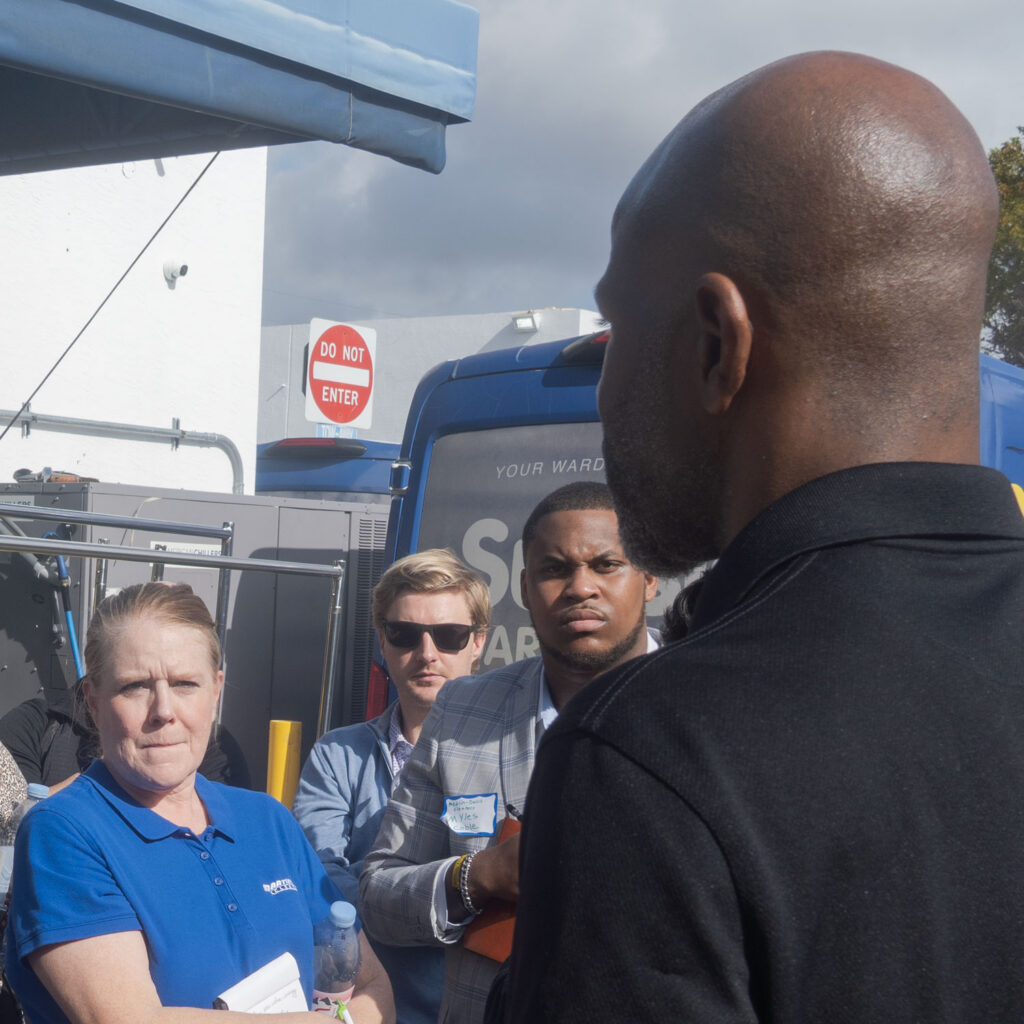
That’s why Makepeace joined other members of the T2 peer group, a collective of operators committed to raising industry standards together, for hands-on training at Sudsies in Miami, where Jason, CEO of Sudsies, and his team regularly host operators looking to elevate their craft.
The training sessions combine classroom discussion with time spent directly inside the plant observing how garments move through the process.
For Makepeace, seeing the operation in person was essential.
“You can’t really learn this in an online class,” he explained. “You have to see the garments, handle them, and watch how experienced people work with them.”
At Sudsies, the team processes thousands of high-end garments every day, giving visiting operators the chance to observe real examples of couture care in action.
Learning to Identify a Couture Garment
One of the most important lessons Makepeace brought back to Raleigh was something deceptively simple.
Recognizing the garment.
Before any special process can begin, someone has to identify which items require couture-level attention. That means learning to look closely at several details: brand labels, country of origin, fabric content, embellishments, and construction techniques.
A garment made in Italy or France from delicate fabrics with intricate detailing may require a completely different approach than a standard piece of clothing.
At Sudsies, Makepeace spent time not only with Jason but also with the production team — dry cleaners, spotters, and pressers who handle these garments every day.
Seeing how experienced technicians evaluate garments helped him refine the training he’s now bringing back to his own staff.
“It’s not just one person making the decision,” he said. “Everyone in production understands what to look for.”
Creating a Separate Couture Process
Back in Raleigh, those lessons have already been shaping how Medlin-Davis operates.
The company’s couture service — branded internally as MDC Handcrafted — is completely separate from the main production process.
Garments identified for this level of care are routed to a dedicated area where they are handled individually rather than flowing through the standard production system.
The department currently includes Makepeace himself and a lead technician who focuses specifically on these garments.
Even the presentation is different.
Couture pieces are packaged with custom hangers, specialized garment covers, and branded materials that reflect the elevated level of service. Pricing also reflects the additional attention required, with couture items carrying an 85 percent premium over standard cleaning prices.
For customers, the difference is visible from the moment they pick up their garments.
Identifying Customers — Not Just Garments
Interestingly, most customers don’t request couture care when they drop off their clothing.
In many cases, they simply trust the cleaner to handle their garments appropriately.
That means the responsibility often falls on the cleaner to recognize when a piece deserves more attention.
In Raleigh, luxury garments are less common than in fashion centers like Miami or New York, so customers may not even realize that specialized services exist.
Because of that, Medlin-Davis has taken a careful approach.
Because of that, Medlin-Davis has taken a careful approach. Rather than launching a full marketing campaign immediately, the company has started by identifying customers who regularly bring in high-end garments.
Staff members reach out personally to explain the service and enroll those customers individually. “Most of the time, the customer has no idea there’s a difference in how we’re handling their garment,” Makepeace said. “So part of our job is just educating them—helping them understand what they already have and why it deserves a different level of care.”
So far, the results have been encouraging.
About fifteen clients now use the service regularly, along with a steady stream of one-off couture items that appear throughout the week.
Once the process feels proven, Makepeace plans to expand marketing to the broader customer base.
Training the Next Generation
The most recent training trip to Miami included someone else from the Medlin-Davis team as well.
Their future dry cleaner.
The company’s current cleaner plans to retire at the end of the year, and his replacement is just beginning his career in the industry.
Makepeace describes him as eager to learn and absorbing everything he can.
For someone new to garment care, seeing a high-level operation like Sudsies can accelerate the learning curve dramatically.
“It was a great opportunity for him,” Makepeace said. “He’s a sponge right now.”
Bringing younger team members into these learning experiences is something Makepeace sees as essential to the future of the business.
The Value of Industry Collaboration
The Sudsies training sessions are organized through the T2 peer group, a network of dry cleaning operators who share ideas, data, and operational insights with one another.
Members come from different regions across the country, which allows them to collaborate openly without competing directly.
Beyond formal training, the group also meets regularly to review each other’s operations, discuss financial performance, and share solutions to common challenges.
The discussions can be direct.
Members openly review financial statements, question unusual expense ratios, and offer suggestions for improving results.
But that honesty is exactly what makes the group valuable.
“We’re sharing everything,” Makepeace explained. “The good and the bad.”
That level of trust allows operators to improve faster than they could on their own.
Craftsmanship Still Matters
For Makepeace, the experience reinforced something important about the garment care industry.
While technology and automation continue to shape many parts of the business, the highest level of garment care still depends on craftsmanship.
Recognizing fabrics, understanding construction, choosing the right cleaning method, and finishing garments properly all require experience and judgment.
Those skills are best learned through observation, mentorship, and hands-on practice.
And sometimes, that means traveling across the country to watch someone else do it well.
Back in Raleigh, the MDC Handcrafted department is still young.
But with each garment that passes through it, the team gains more experience — and more confidence that the garments passing through their hands are getting exactly the care they deserve.