
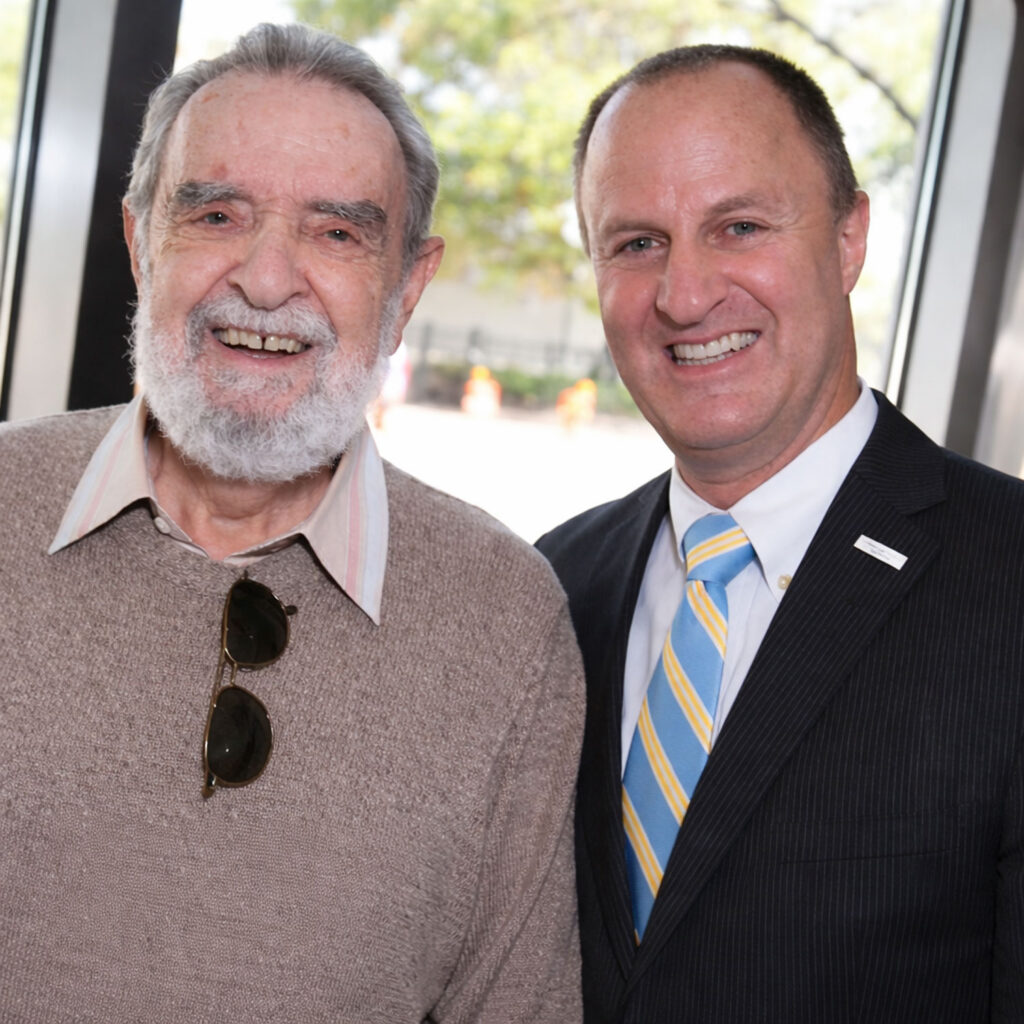
Miami Beach has always been a city of surfaces and reinvention. New façades rise, restaurants come and go, hotel lobbies are refreshed, and each season seems to bring another wave of people determined to leave their mark on a narrow stretch of sand between Biscayne Bay and the Atlantic. Yet for all of its appetite for novelty, Miami Beach remains, at heart, a city built on continuity. Its real character is still carried by the families, institutions, and friendships that have endured beneath the shifting gloss.
Michael S. Goldberg belongs to that deeper Miami Beach.
For him, the city is not simply a place of residence or business. It is family history. It is inheritance. It is memory layered across generations. Few stories illustrate that more clearly than the Goldberg family’s connection to Miami Beach High School, one of the city’s enduring civic touchstones. Michael’s father graduated in the Class of 1951. Michael followed in 1981. Years later, his own children continued the line, graduating in 2007 and 2015. In a place so often defined by arrivals, that kind of continuity feels almost old-world. It suggests not only longevity, but belonging.
That sense of belonging matters in Miami Beach. This is a city that has always rewarded vision, but it has also depended on stewardship. Long before glossy towers and branded residences became part of the local vocabulary, there were people who gave their time to boards, committees, schools, chambers, and neighborhood institutions, not for spectacle, but because they believed the life of the city deserved their care. Michael’s story belongs to that tradition.
His father once served as Chairman of the Miami Beach Chamber of Commerce. Decades later, Michael would follow him into that same role, serving as Chairman from 2013 through 2016. Together, they remain the only father-and-son pair ever to chair the Chamber, a distinction that says as much about family culture as it does about civic accomplishment. Both also served as Chairmen of the City of Miami Beach Zoning Board of Adjustments at different points in time, another rare symmetry in a city where land use, development, and preservation have always carried unusually high stakes.
None of this feels incidental. In Miami Beach, civic service has always required a particular kind of temperament. The city is beautiful, but it is rarely simple. It asks leaders to balance growth with neighborhood character, commerce with culture, and ambition with restraint. Michael has long understood that these roles are not merely honorary. They are forms of participation in the ongoing making of the city.
For him, that participation has always been personal. He speaks about civic involvement not as résumé architecture, but as repayment of a debt of gratitude. The city, after all, has been good to three generations of the Goldberg family. His leadership has reflected a belief that belonging should be answered with contribution.
That is one of the things I have always admired about him.
What makes our friendship especially interesting is how improbably it began. Michael grew up on North Bay Road. I grew up on North Shore Drive. In Miami Beach terms, those are not distant worlds. The city is only so large. Its geography is intimate, almost improbably so. The idea that two boys growing up within the same small municipal tapestry could miss each other entirely now seems hard to believe. But Miami Beach has always had its own internal villages, its own rhythms, its own invisible lines of movement. Somehow, despite growing up just a few miles apart, we never met.
It was only later, when we were both in our thirties, that our paths finally crossed. By then we were each building careers, becoming more involved in the Chamber, and finding our footing in the civic and professional life of the city. When we were introduced, the connection felt immediate. Some friendships take shape gradually. Others arrive with the strange force of recognition, as though they had simply been delayed. Ours was very much the latter.
The more time we spent together, the more surprising it seemed that we had not met years earlier. We shared not only local roots, but a common instinct about business and community. We both believed that relationships matter more than transactions, that trust is built slowly, and that reputation is still one of the few assets that cannot be manufactured on demand. In a city as kinetic as Miami Beach, where the social and professional worlds often overlap in unpredictable ways, that shared outlook created a strong foundation.
Our friendship soon extended beyond professional circles. I was even involved in planning Michael’s surprise 40th birthday party, which is perhaps the sort of detail that reveals more than any formal biography could. It speaks to the ease of the friendship and to the way relationships in Miami Beach often develop. The city may project glamour to the outside world, but at its core it remains a place where personal networks, family histories, and long-held loyalties still matter.
Over time, that friendship evolved into collaboration. Together, we helped launch the Chamber’s Ambassador Program, an initiative designed to welcome and mentor new members. The premise was simple, but important. Business communities do not become stronger by accident. They become stronger when people are taught how to build real relationships, how to show up consistently, and how to understand that credibility is earned through trust rather than performance alone.
That idea has always resonated with both of us. In banking, in garment care, in civic life, and in leadership, the principle remains remarkably constant. Relationships make the difference. Not in the superficial language of networking, but in the deeper sense of knowing people well, showing up for them reliably, and understanding that community is built over time, through repeated acts of seriousness and goodwill.
Michael embodies that ethos in a way that feels distinctly Miami Beach, though perhaps not in the way outsiders might first imagine. He is not a symbol of the city’s flash. He is a reminder of its substance. He reflects the Miami Beach of civic boards and school loyalties, of Chamber lunches and family names that still carry stories, of people who understand that a city’s future depends not only on investment, but on continuity.
In that sense, his story is about far more than one family’s legacy. It is about the kind of local leadership that gives a place its texture. It is about what happens when roots deepen rather than fade. It is about the value of staying engaged in a city that is always in motion.
Miami Beach will continue to change. That is part of its nature. The skyline will shift again. New names will appear. Different industries will leave their imprint. But cities need memory as much as they need momentum. They need people who carry forward not only success, but stewardship.
Michael S. Goldberg is part of that inheritance.
And in a place as restless, sunlit, and self-renewing as Miami Beach, that may be one of the rarest distinctions of all.